Mxwll
The quality layer for science - design-led real-time data for curious people.
Mxwll is the quality layer for science - a design-led real-time data platform and digital publication presenting scientific information with the care usually reserved for luxury products or art books.
Mxwll platform overview
The Problem
All the science is already out there. NASA publishes live solar imagery. NOAA streams space weather data. USGS tracks every earthquake in real time. Thousands of papers are published daily.
But accessing it means navigating government websites designed in 2003, paywalled journals with hostile interfaces, and PDFs that haven't been touched since digitisation. The raw material of science is abundant and largely free. What's missing is the presentation layer - the curation, design, and craft that makes it accessible, beautiful, and trustworthy.
Mxwll is that presentation layer.
The Model
The underlying content is often free. What people value is someone with good judgment deciding what matters, beautiful and functional presentation, and a reliable place to return to.
This is the same model that made Flightradar24 (acquired for $1B+ despite presenting public flight data), the Criterion Collection (licensing films anyone can access), and earth.nullschool.net (public weather data made mesmerising).
Mxwll applies this model to science. Taste + presentation + trust = value.
What I Built
Observe
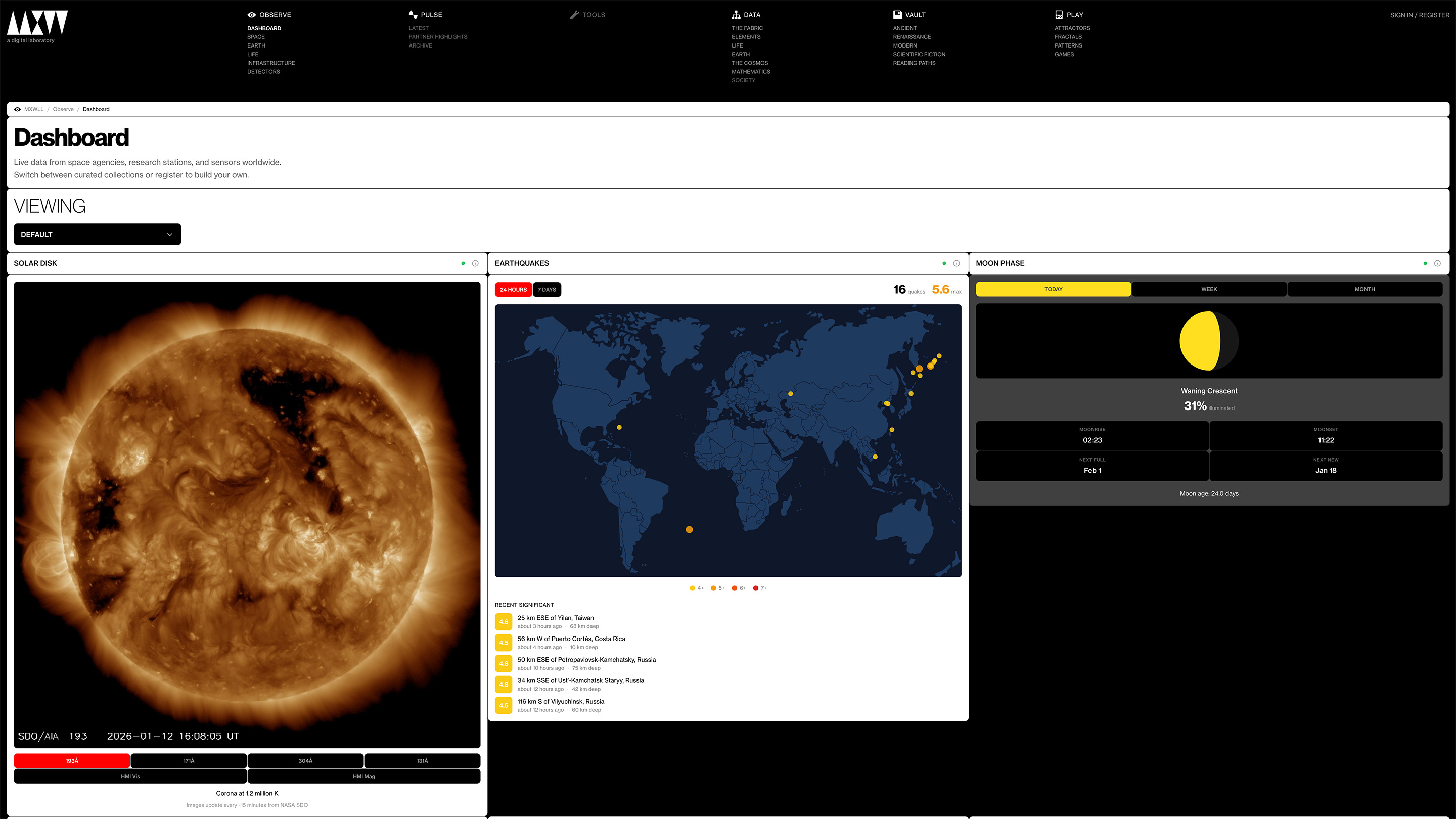
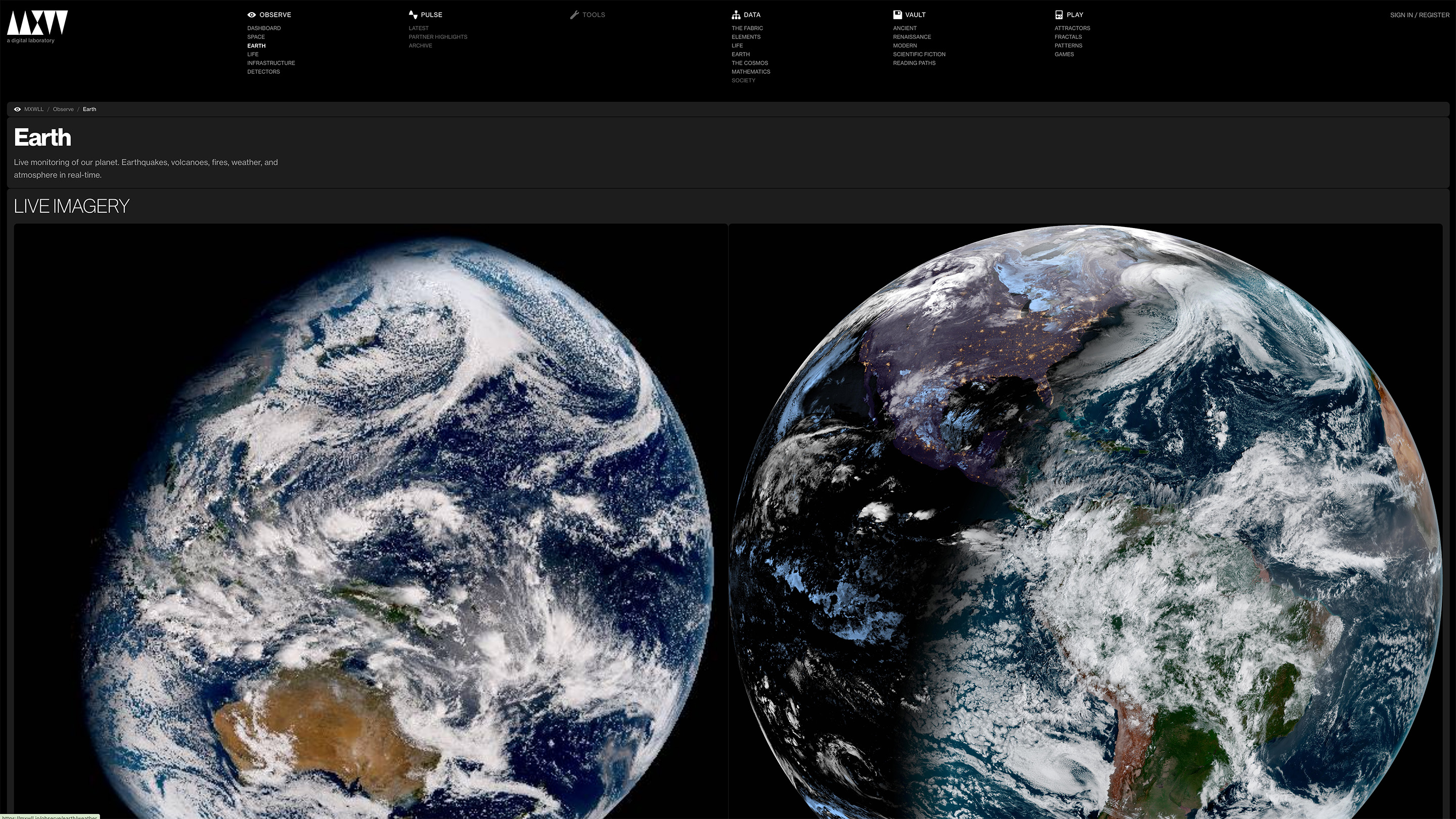
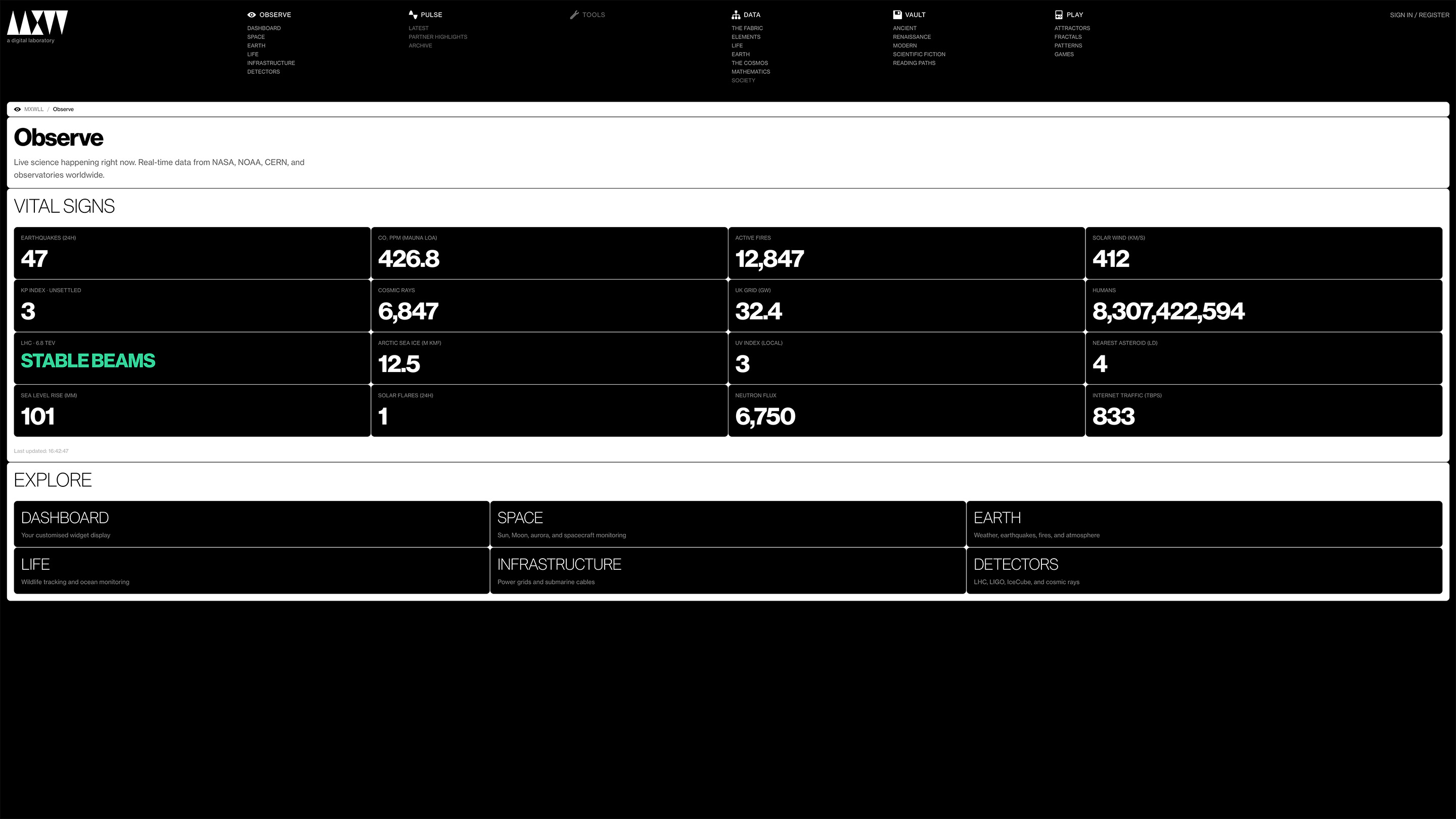
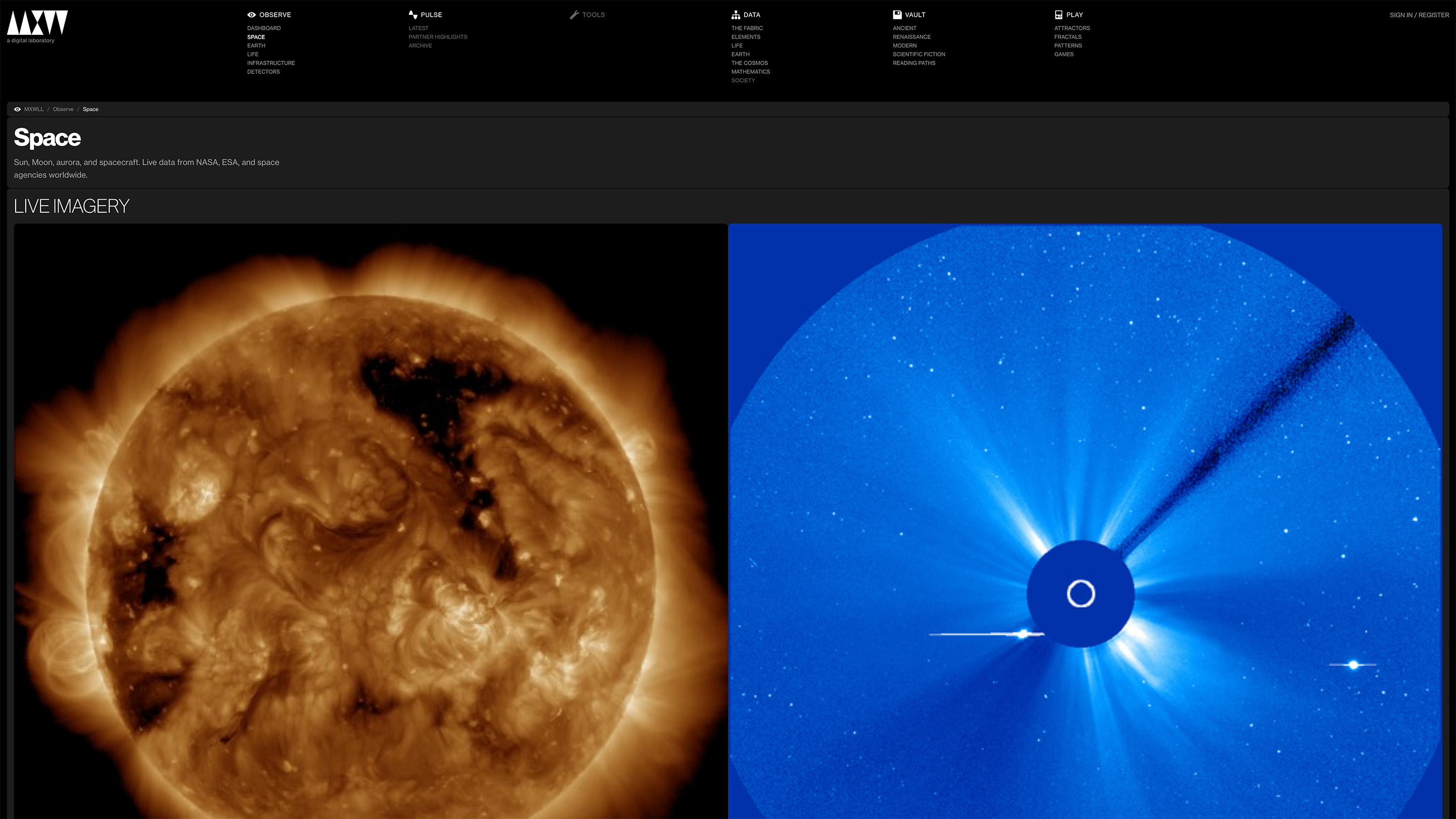
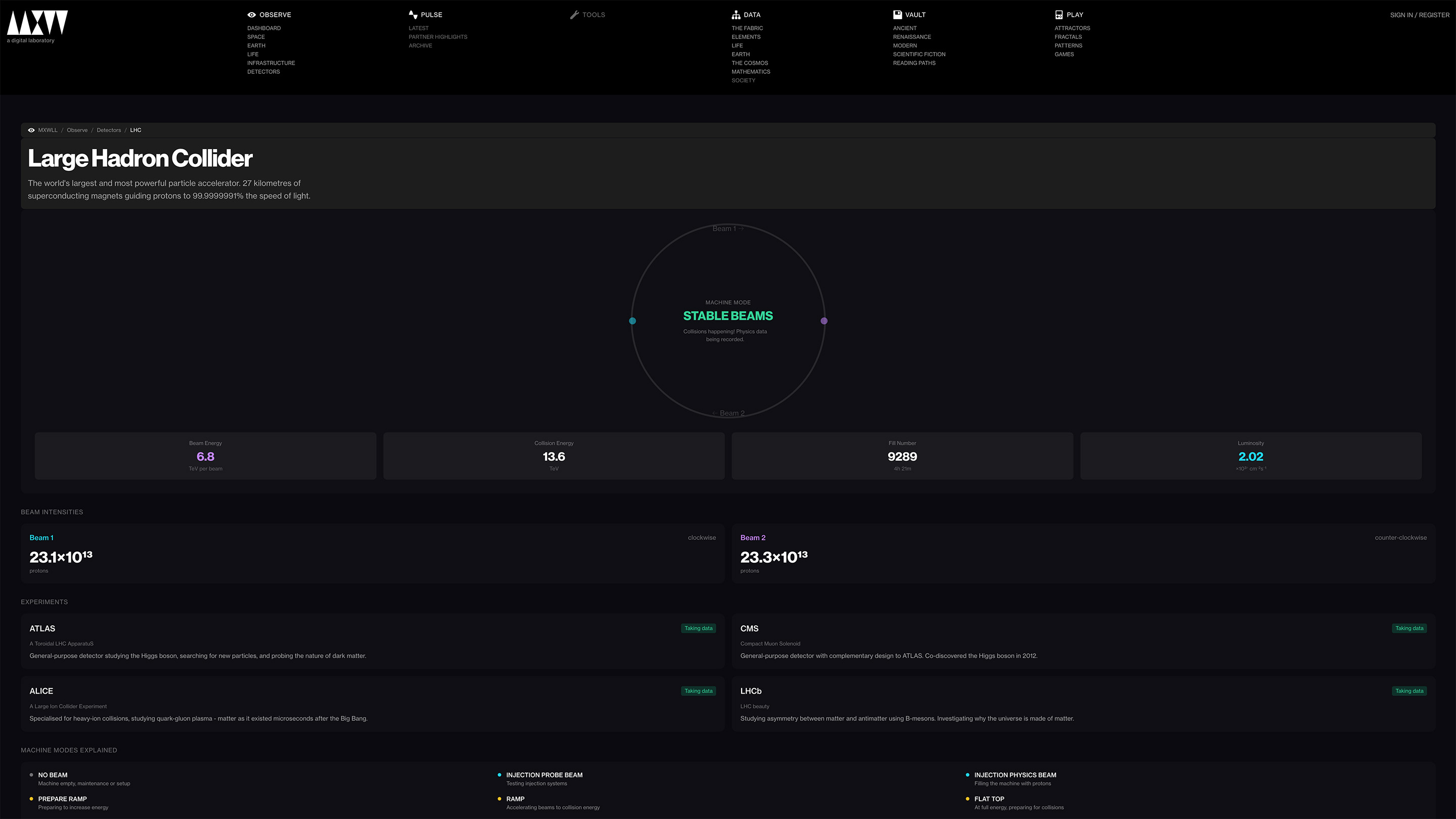
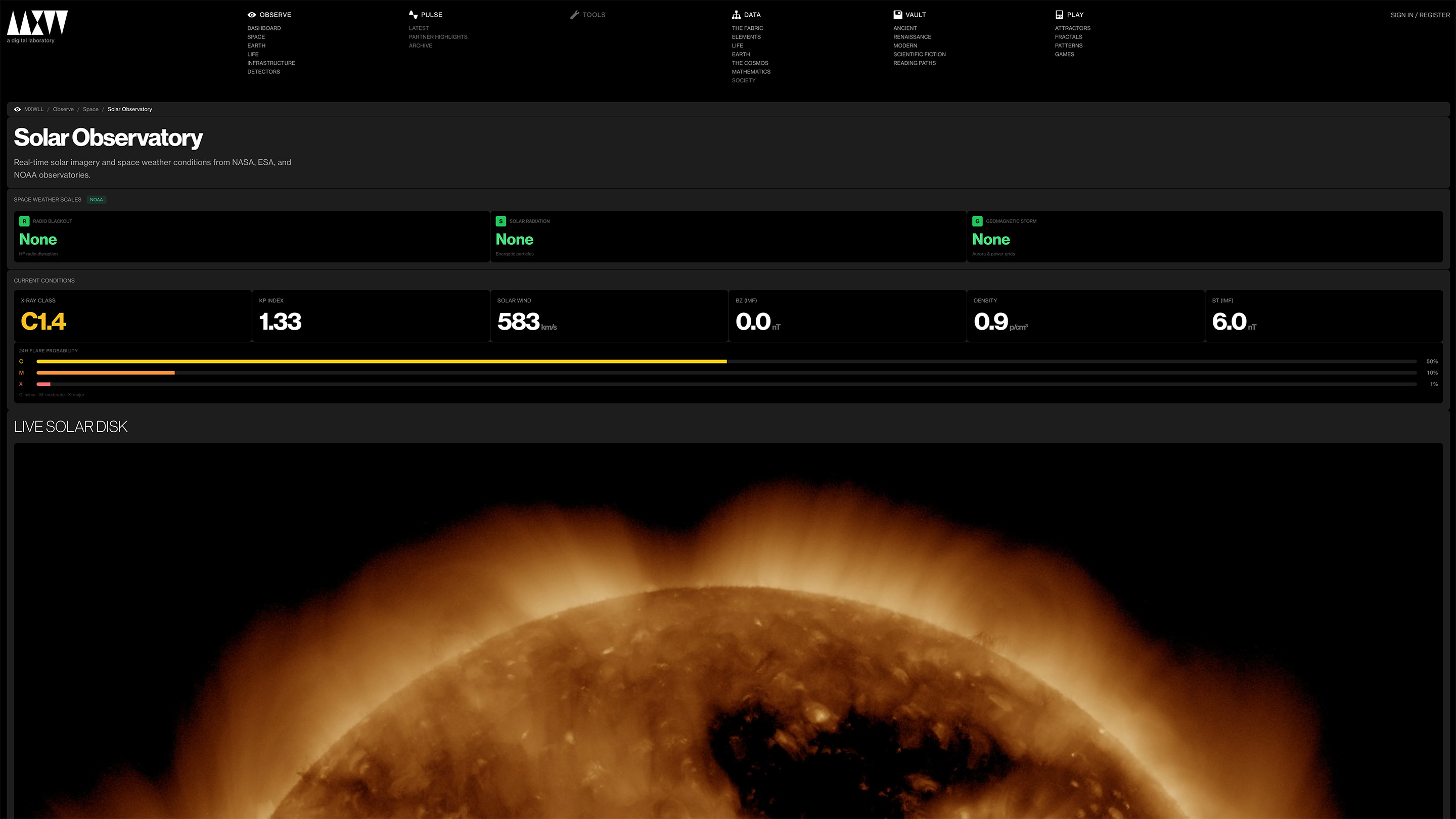
Real-time feeds from NASA, NOAA, weather satellites, seismology networks, and particle physics experiments. 40+ widgets across space, earth, life, infrastructure, and detectors:
- •Solar observatory with multi-wavelength disc viewers (SDO, SOHO, STEREO)
- •Live earthquake mapping and seismograph grid
- •Space station tracking with crew data
- •LHC beam status and luminosity
- •Gravitational wave detector status (LIGO/Virgo)
- •Neutrino event alerts from IceCube at the South Pole
- •Cosmic ray monitoring
- •UK energy generation mix and carbon intensity
- •Global fire and lightning detection
Orbital Platform
Multi-scale visualisation engine for everything from LEO satellites to Voyager at the edge of the solar system:
- •Sun-Earth-Moon orrery using VSOP87 planetary positions
- •Real-time Voyager 1 & 2 tracking at 20+ billion km using JPL Horizons ephemeris
- •Live ISS/Tiangong tracking with TLE/SGP4 propagation
- •Comet trajectories using Keplerian orbital mechanics
- •Near-Earth asteroid close approach calendar
Data Visualisation
Complex scientific datasets rendered as clear, interactive charts:
- •Climate data spanning decades with 38 datasets
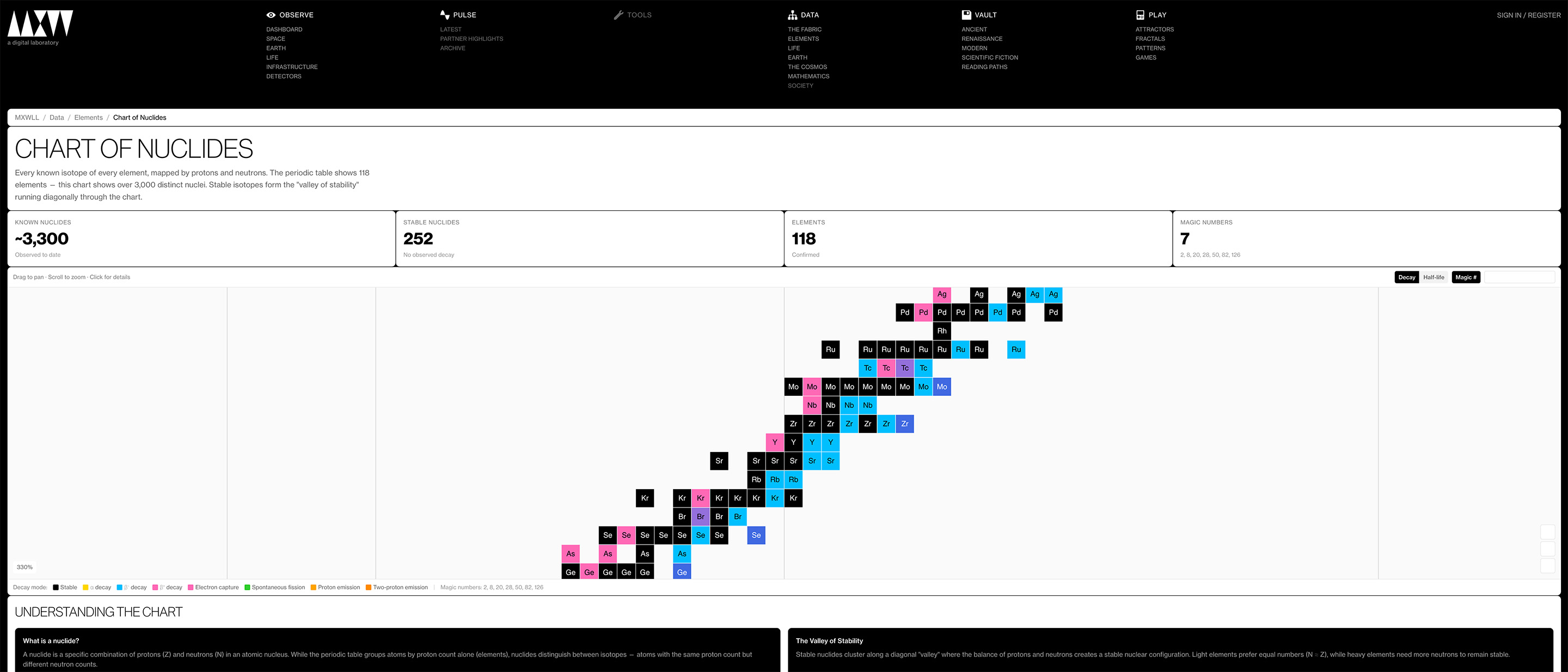
- •Chart of nuclides - every known isotope plotted by decay type and half-life
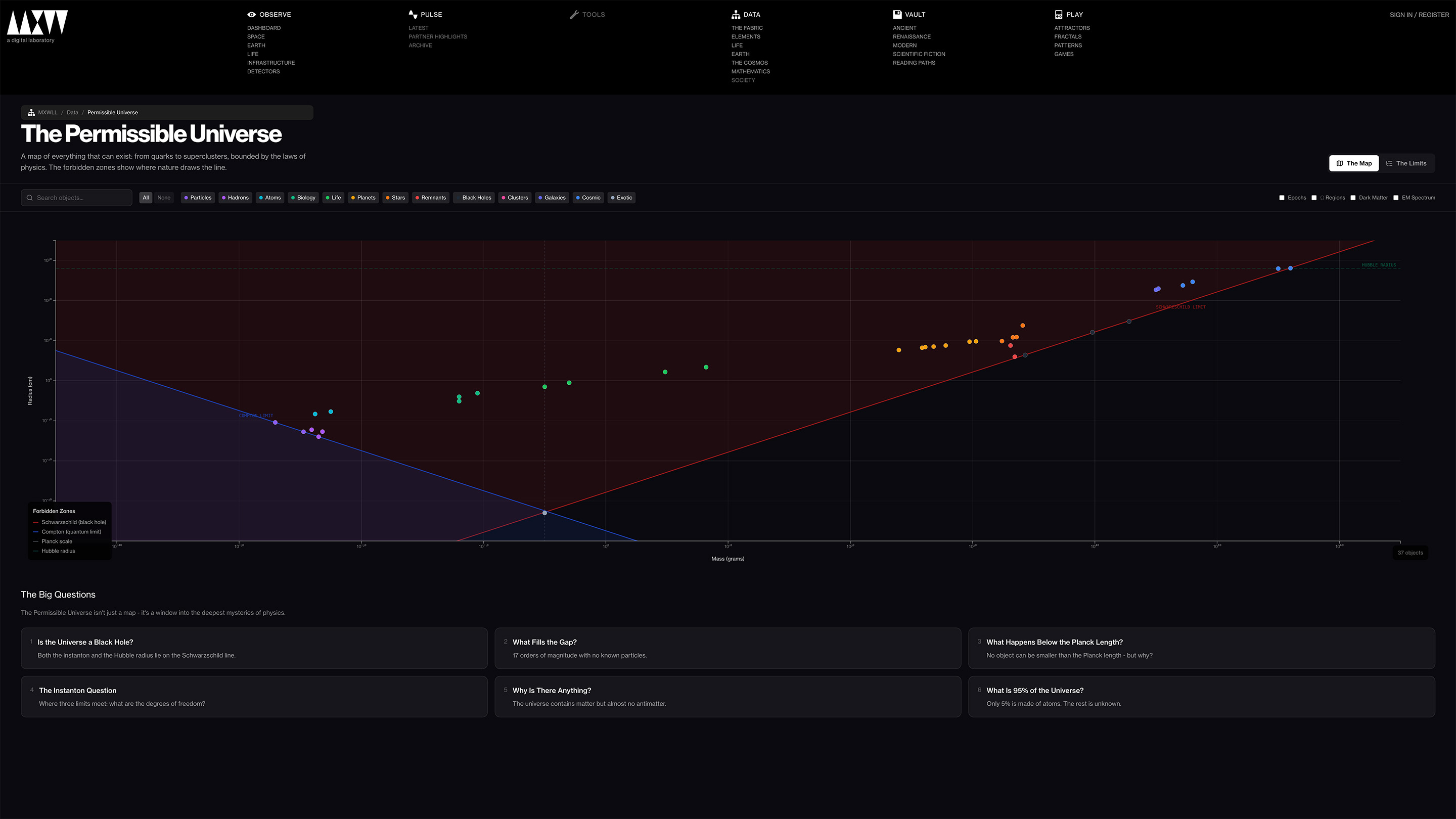
- •Electromagnetic spectrum spanning 19 orders of magnitude
- •Standard Model of particle physics
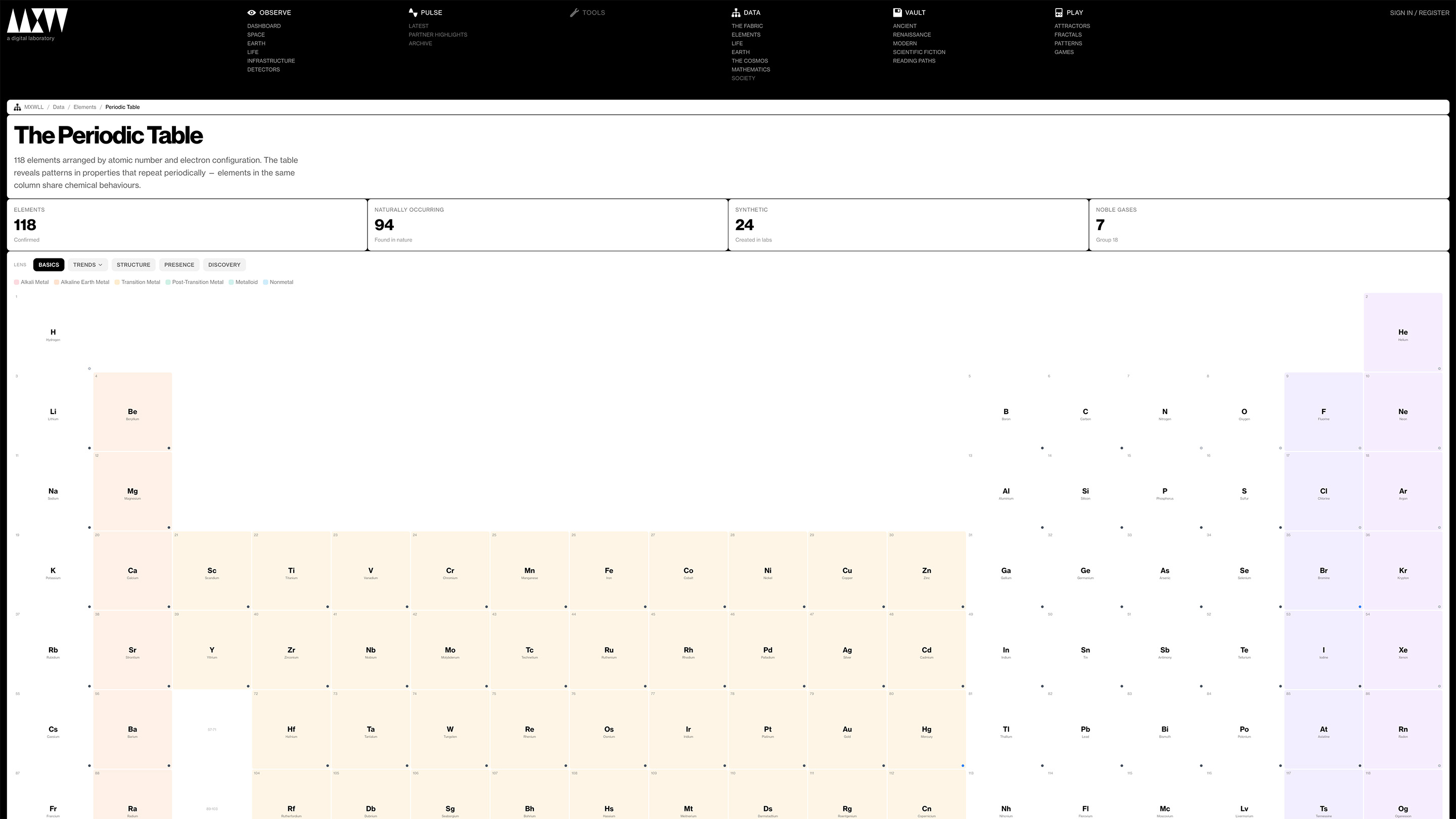
- •Periodic table with trend visualisation and element exploration
Vault
Curated scientific library presenting foundational texts with editorial context and typographic care. Classic papers and landmark discoveries, reformatted for modern reading.
Play
15+ interactive mathematical visualisations: strange attractors (Lorenz, Rössler, Aizawa), fractals, cellular automata, pattern formation systems. Mathematical beauty as exploration.
Technical Implementation
| Area | Stack |
| Framework | Next.js 14+, React, TypeScript |
| 3D | Three.js, React Three Fiber |
| Charts | D3.js, Canvas 2D |
| Data | 20+ scientific APIs (NASA, NOAA, USGS, JPL, CelesTrak, CERN, ESA) |
| Caching | Vercel KV, stale-while-revalidate patterns |
| Deployment | Vercel |
Orbital mechanics:
- •Floating origin (camera at 0,0,0) to prevent floating-point jitter at planetary scales
- •Logarithmic depth buffer for LEO to heliocentric scale rendering
- •Three propagation regimes: SGP4 for Earth-orbiting satellites, Keplerian mechanics for solar system bodies, JPL ephemeris interpolation for spacecraft
- •Web Workers for off-thread propagation calculations
Why It Matters
Science deserves better presentation. The invisible processes that shape our world - stars fusing, particles decaying, plates shifting, data flowing - mostly go unseen. Mxwll builds windows into these processes. Beautiful windows. Trustworthy windows.
The differentiator isn't more data or more features. It's design quality, editorial clarity, and the conviction that curious people deserve better than what currently exists.